
Research
Chora
From 2020-2025 I am researching Plato's chora and the basho of the Kyoto School at the Dutch Open Universiteit.
Plato tells in his dialogue Timaeus a Pythagorean creation myth, introducing an enigmatic third kind of reality beyond Being and Becoming: the Χώρα (chora/khôra). The Χώρα is a space or field, ‘invisible and formless, all-embracing, possessed in a most puzzling way of intelligibility, yet very hard to grasp’ (Tim. 51A). The Χώρα cannot be grasped by the mind or the senses, it is ‘scarcely believable’ and is ‘looked at in a kind of dream’ (Tim. 52B). This idea has puzzled subsequent thinkers in Western philosophy from Aristotle to Jacques Derrida. Outside the discipline of Western philosophy, the Χώρα has made an appearance in such divergent fields as poetry, alchemy, theology, semiotics, psychology, architecture and Zen Buddhist philosophy. My intention is to survey important moments in the history of the idea of the Χώρα and present them in a way that is accessible to both the general academic reader and the specialist.
In the ancient Greek language, the word ‘χώρα’ did not become a philosophical term until employed by Plato, so we may take his use of it in the Timaeus as our starting point. When tracing a line of descent there is a hermeneutical risk of constructing continuity where none actually exists; therefor I will follow the Platonic concept only where it is directly quoted or obviously alluded to. However, the Χώρα requires additional hermeneutical attention since its meaning in the history of its reception often seems to diverge from Plato’s intention. This is already apparent in Aristotle, who introduced ὕλη (hyle) as formless matter, which in Greek philosophy became entangled with the Χώρα as prima materia. The aim of my research is to show how each scholar constructs his/her own understanding of the Χώρα both within and outside the Platonic framework.
Plato presents the Χώρα as a reality. In the cosmology of the Timaeus, ideas belong to the sphere of Being and the reality of the Χώρα is explicitly positioned beyond Being. How can one write the history of an idea that is not an idea? Perhaps this paper should be called ‘Χώρα: The History of an Idea, or Idea’, as Heidegger would have it. Jacques Derrida has made a case for this approach when he wrote:
We will never exhaust the immense literature devoted to the Timaeus since antiquity. It is out of the question to deal with it here in its entirety. (…) Rich, numerous, inexhaustible, the interpretations come, in short, to give form to the meaning of khōra. They always consist in giving form to it by determining it, it which, however, can “offer itself” or promise itself only by removing itself from any determination, from all marks or impressions to which we say it is exposed: from everything which we would like to give to it without hoping to receive anything from it … ’ (Jacques Derrida, Khōra, p. 94).
By raising one characteristic of the Χώρα, namely its putative formlessness, to the status of the only true aspect, and by reducing other characteristics to the level of metaphors¸ Derrida creates in this deconstructive reading his own khōra at the expense of the historical background of the idea. If the Χώρα is completely emptied of form and unrelated to a cosmological framework, any word or sign can take its place. It is exactly this aspect of the Χώρα that appeals to many post-Enlightenment thinkers, for whom the ancient teleological creation myth no longer resonates.
The Χώρα seems to be an idea that defies all rational thought; is there a point in writing about it? In the history of the Χώρα, there are important connections to mystical Neoplatonic theology and hence to Christian apophatic theology or via negativa, which stretches from antiquity to the present. These writings allude to mystical experiences of reality which, like the Χώρα, are difficult to articulate because of their paradoxical nature. This puzzling aspect of the Χώρα may be fruitfully juxtaposed with strands of thought drawn from Eastern traditions. Plato was studied in the twentieth century by the philosophers of the Japanese ‘Kyoto School’, who formulated the Zen Buddhist experience of ultimate reality with concepts borrowed from Western philosophy. The founder of the Kyoto School, Nishida Kitarō, modelled his paradox of ‘form without form’, basho (場所), on Plato’s Χώρα. This idea became an important cornerstone to the Kyoto School. For instance, his student Nishitani Keiji writes that ‘we see the nothingness of the self rise up to serve as a locus (like the Χώρα that Plato speaks of in the Timaeus) for receiving redeeming love’ (Nishitani, Religion and Nothingness, p. 25). My argument will be that Χώρα, as interpreted by the Kyoto School, connects Eastern and Western, ancient and contemporary philosophy, mysticism and religion in a way that illustrates the enduring relevance of the study of the Platonic enigma.
John Tavener and Sacred Silence

In Heart's Ease, Spirituality in the Music of John Tavener, June Boyce-Tillman has kindly allowed me to publish a chapter on 'John Tavener and Sacred Silence'. My contribution comes out of a number of presentations at the Tavener Study Days in Winchester, both as research and through musical performances inspired by Tavener. The contributors to this book include scholars, musicians, theologians, medical practitioners, informed listeners and practitioners in religious traditions. It includes case study material, empirical studies, philosophical, theological and theoretical contributions along with accounts from lived experience of the spirituality generated by Tavener’s music. Warmly recommended!
Star Music
As MPhil postgraduate research at Canterbury Christchurch University, UK, I wrote a thesis on 'Star Music. The ancient idea of cosmic music as a philosophical paradox'. Here's the abstract:
‘Star Music’ regards the ancient Pythagorean-Platonic idea of heavenly harmony as a philosophical paradox: stars are silent, music is not. The idea of ‘star music’ contains several potential opposites, including imagination and sense perception, the temporal and the eternal, transcendence and theophany, and others. The idea of ‘star music’ as a paradox can become a gateway to a different understanding of the universe, and a vehicle for a shift to a new – and yet very ancient – form of consciousness. The ancient Greeks had a type of unitary consciousness, intermingling continually with a transpersonal dimension. This ancient state of consciousness was related to a musical understanding of the world, the Pythagorean-Platonic experience of the universe as an ordered cosmos. The research is approached from the angle of musicianship, exploring how music is reflected in the world of thought. By reflexive re-reading of the primary sources, new insights into the nature of musical consciousness are explored. The idea of ‘star music’ can be found throughout the history of music and thought in the West, including Plato’s works and that of other ancient philosophers, through the Middle Ages, the Renaissance, the Romantic era and the twentieth century up to contemporary New Age music. As a conclusion, the paradox of ‘star music’ is connected to an experience of a shared transcendent meaning of music, which can be present in the moment of a musical performance. In other words, ‘star music’ is a living paradox.
Chapter titles are: Introduction: the paradox of ‘star music’ ; The Pythagorean roots ; Plato’s musical creation ; The musical cosmos of antiquity ; Medieval heavenly harmony; The musica mundana of the Italian Renaissance ; The absolute music of the Romantic era ; The rediscovery of the world soul ; Pythagoras for the New Age ; Conclusion. The complete thesis you can download at https://repository.canterbury.ac.uk/item/88649/star-music-the-ancient-idea-of-cosmic-musicas-a-philosophical-paradox or at https://www.academia.edu/ .
Tone-Zodiac

The text below is an excerpt from an essay written for the MA on Myth, Cosmology and the Sacred of Canterbury Christ Church University in 2015. The complete essay is available at https://www.academia.edu/.
A tone-zodiac is a circle indicating the connections between the twelve signs of the zodiac and the tones of a musical scale. The oldest known tone-zodiac is found in Ptolemy’s Harmonics (second century CE). It is founded on the vision of Pythagoras of the heavens as a musical harmony. The tone-zodiac is not expressing the generally known ‘Harmony of the Spheres’, which is based on the planetary movements, but connects music with the properties of the ‘fixed stars’, the constellations of the zodiac. To each star sign a note is assigned, thus creating a circle of sounds and images. History has produced a small number of tone-zodiacs.
The oldest known tone-zodiac appears in The Harmonics by the Alexandrian Ptolemy (c. 90 – c. 168 CE). He presents his tone-zodiacs in chapter 8 of book III of the Harmonics, written near the end of his life. He lays out a two-octave Pythagorean scale on a zodiac circle, noting that the rotating movements of the stars are all circular and regular and similar to the movements within the tone-system. In this form of the tone-zodiac, the octave (2:1) comes opposite in the circle, and so cuts it in two (1:2), which he considers “a great mystery”. Ptolemy says that “for this reason the effect of the planets is at its strongest in opposition, when they occupy diametrically opposed positions in the zodiac, and a similar relationship obtains among tones which are an octave apart from one another”.1 To the modern sense of consonance it seems strange to portray opposition by the octave and conjunction by the double octave.
Ptolemy continues his argument in the Harmonics with a comparison of the rising and falling motion of stars with the genera in music. This comparison, based on the tropics, connects the seven Greek modes with the twelve star signs: Cancer - Mixolydian; Gemini / Leo - Lydian; Taurus / Virgo - Phrygian; Aries / Libra - Dorian; Pisces / Scorpio - Hypolydian; Aquarius / Sagittarius - Hypophrygian; Capricorn - Hypodorian. Finally, Ptolemy presents a tone-zodiac of two octaves showing the course of the moon, exemplifying that of all the planets, from its conjunction with the sun at the dark of the moon.
After Ptolemy ancient and medieval scholars in Western Europe discussed the connections between the planetary movements and the musical scale, but not to the zodiac. As more Greek sources became available in the second millennium CE the interest in ancient science, including astrology, grew. In the Italian Renaissance the tone-zodiac surfaces again.
Marsilio Ficino (1433-1499) presents a tone-zodiac in his letter to the musician-philosopher Domenico Benivieni2. He uses a one-octave scale and places the major seventh as the opposite aspect. However, he manages to keep the Ptolemaic consonances of whole-tone (sextile), fourth (square) and fifth (trine) in the same place.3 Angela Voss4 argues that Ficino is advocating in his letter a tuning system in accordance with contemporary practice and the requirements of musicians, and which correlates more exactly with astrological law. As Ficino was a practising astrologer and a musician himself he may have chosen to adapt the Ptolemaic tone-zodiac to fit his own practice.
Johannes Kepler (1571-1630) tried to show that the geometry of the heavens is ruled by musical harmony, connected to the Platonic solids. In his Mysterium Cosmographicum (1596) he elaborates on Ptolemy’s tone-zodiac, based on the double-octave scale, introducing correspondences between the astrological aspects and the regular plane figures of geometry. Kepler also signals the problem of comparing the arithmetically divided circle of the Zodiac with the logarithmically divided string.5
Even if they did not discriminate between astronomy and astrology as modern science does, Ptolemy, Ficino and Kepler made a connection between astrological geometry and musical ratios, not between the character of the zodiacal signs and music. In the Age of Enlightenment no new tone-zodiacs appear. The renewed interest in the esoteric wisdom of antiquity during the nineteenth century reintroduces the tone-zodiac, which flowers in the theosophical and anthroposophical movements.
The Anthroposophical tone-zodiac, based on the ideas of Rudolf Steiner, not only connects the star signs with the major and minor keys, but is represents the twelve creative figurations of the archangels, the Seraphim and Cherubim, so that each tone exists as sound and as inner experience on the etheric and astral levels.6 Steiner’s student Anny von Lange (1887-1959) worked these ideas out in her book 'Man, Music and Cosmos'(1956). On her tone-zodiac she writes: “These twelve heavenly spheres are portals for the incoming cosmic forming forces which work upon man, each in its own appointed way.”7
A modern tone-zodiac has been created by the composer Karlheinz Stockhausen (1928-2007) for his cycle TIERKREIS(German for zodiac), consisting of twelve melodies, each representing one sign of the zodiac. The TIERKREIS melodies are constructed on several series that rule pitch and duration. The Zentraltöne of the melodies form a chromatic scale. The tempos of the melodies are ordered like a chromatic scale. On the cover of his composition these and more relations are summarized in a tone-zodiac.
The tone-zodiac symbol brings the signs of the zodiac and music together within the Pythagorean-Platonic vision of heavenly harmony, which is also the basis of the planetary Harmony of the Spheres. The circle of star signs connects the tones of a scale to the signs of the zodiac, and beyond that to the revolutions of the heavens that reflect divine reason and eternity. The circle of musical tones builds on the division of the octave in the twelve steps of equal temperament, but the power to move is its special feature. From a psychological standpoint the tone-zodiac refers to music as a non-rational, participatory state of consciousness just as the star signs belong to an animated worldview and a divinatory attitude. The circle itself points at a transcendent unity, to Plato’s ‘Spindle of Ananke’ as the axis mundi, bringing music and astrology together in an unknown synthesis.
- Godwin, J. (1993) The Harmony of the Spheres: A Sourcebook of the Pythagorean Tradition in Music. Rochester: Inner Traditions. p. 31
- Godwin 1993: 168
- Godwin 1993: 32
- Voss, A. (2006) Marsilio Ficino. Berkeley: North Atlantic Books. p. 187
- Godwin 1993: 228, 454
- Godwin, J. (1987) Harmonies of Heaven and Earth. Mysticism in Music. London: Thames and Hudson. p. 147
- Lange, A. von (1956-1992) Man, Music and the Cosmos. Translated by F. Hough. Forest Row Sussex: Rudolf Steiner Press. p. 309
I recommend Roel Hollander's webpage on THE ASTROLOGICAL ZODIAC & TONALITY .
The Sacred Tree
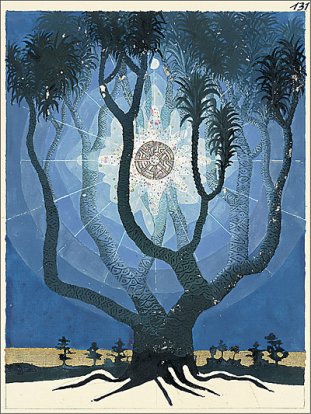
Excerpt from an essay written for the MA on Myth, Cosmology and the Sacred of Canterbury Christ Church University in 2015.
When I see a tree with an open mind I sense having an unusual reaction. The tree is there to see in perceptible reality and yet it is experienced as an inner image, merging with and empowering the visible world with its otherworldly qualities. There is something timeless about this experience in a very comforting way. It gives me roots and strength, it raises me up. Is this unique? No, the experience of the tree as a magic or sacred symbol is common to mankind from time immemorial and holds a special place in religion, mythology and cosmology.
A tree is a perennial plant with a trunk, supporting branches and leaves. Below the ground, the roots spread out; they serve to anchor the tree and extract moisture and nutrients from the soil. Above ground, the branches divide into smaller branches and shoots, bearing leaves, which capture light energy and convert it into chemical energy by photosynthesis, providing the food needed by the tree for its growth and development.
Encountering a tree is an everyday experience for mankind. They are all around; an estimated 27% of the terrestrial surface of Earth is covered by forests and trees make up around 90% of earth’s biomass. Trees have dominated the earth’s surface for over 370 million years. They live much longer than man, on average between 80 (apple) to 400 (chestnut) years but some reaching several thousand years. The most surprising aspect I think is the fact that trees don’t die from old age, they keep on growing until disease, fire, storm or the axe will destroy them. Trees support our life with fruit, timber, fuel, shade, shelter and - less obviously - with oxygen.
A symbol is something that has both a conscious and unconscious meaning and is therefore bridging a gap between different modes of knowledge. If it is just pointing towards something else, it is called a sign and not a symbol. If it is a symbol it always has something special to it, magic or sacred. So a symbolic tree is just a tree and yet it is something else in a mysterious way. Because a symbol means more than just the literal sense, it brings together different meanings or levels of meaning and therefore has a unifying or reconciling power. To determine the meaning of a symbol is becoming conscious of the hidden, unconscious content and therefore provides an interpretation that adds meaning. Using symbols in speech, writing or any form of art is generally called ‘allegory’, from Greek ἀλληγορία.
The tree I take as a symbol of the self in the Jungian sense, bridging consciousness and the unconscious. Jung has made this very clear when he connected the tree symbol with the mandala: “If a mandala may be described as a symbol of the self seen in cross section, then the tree would represent a profile view of it: the self depicted as a process of growth.” As an allegory it depicts long lasting growth: it grows from the earth towards the sky, showing life as a process that leads from the roots in the dark depths of matter towards the highest regions. In a moral sense the tree may stand for steadfastness and perseverance or for a collective centre. Finally the tree reaches up to the light of heaven and so becomes a symbol of the longing of the soul for a union with God. What makes the tree symbol very special is its universal appearance, ranging from the Cross on which Jesus Christ died to the Tree of Life of Darwin’s rather unbiblical universe.
In his Septem Sermones Jung depicts the Tree of Life as a “god-devil”, that ”buddeth, as in growing it heapeth up living stuff.” The “tree of life groweth with slow and constant increase through unmeasured time.” With this image of the Tree of Life as a symbol for all living things we enter a universe where creation is governed by a force of “Life, altogether indefinite, the mother of good and evil” which Jung calls “Abraxas”.
 create websites